On October 13, Zaozhuang University held a meeting in Room 113 of Mingli Building on the Xuecheng Campus to advance follow-up improvement work for the new round of undergraduate education and teaching review and evaluation. Gao Feng, Secretary of the CPC Zaozhuang University Committee, attended the meeting and delivered remarks. Cong Hailin, Deputy Secretary of the CPC Zaozhuang University Committee and President of Zaozhuang University, deployed the next phase of improvement work. University leaders Feng Lei, An Tao, Wu Shangmin, Li Cunjie, Lin Yong, Yuan Junxian, and Yan Xin attended the meeting. The meeting was chaired by An Tao, Member of the CPC Zaozhuang University Committee and Vice President of Zaozhuang University.
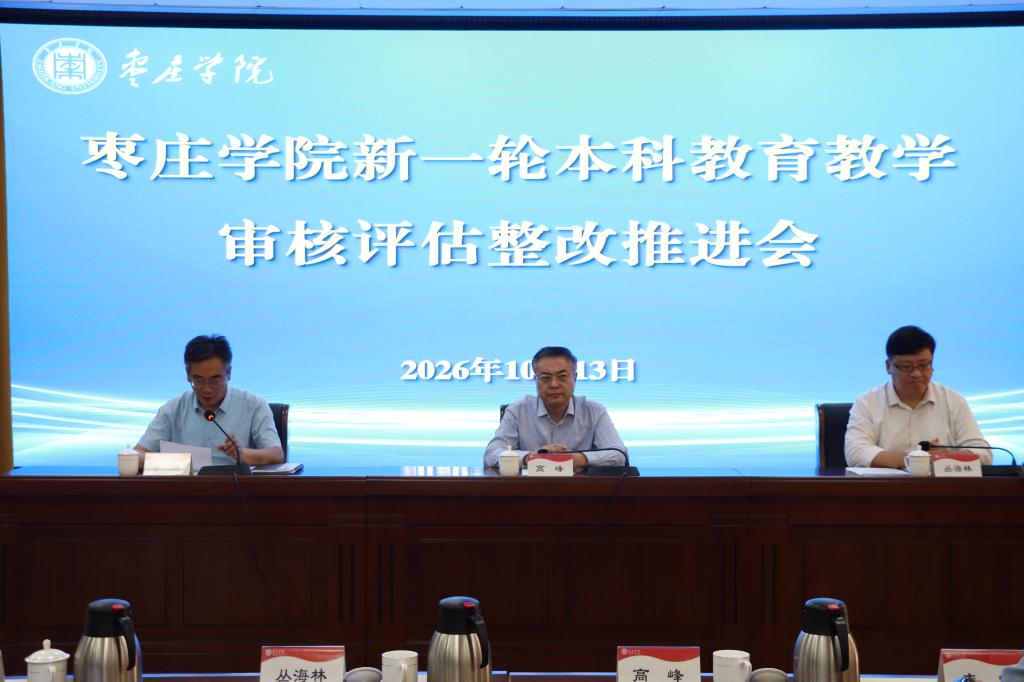
Gao Feng set out three requirements for the follow-up improvement work.
First, the university should raise political awareness and strengthen its sense of responsibility and mission, and all faculty and staff, especially Party members and leading cadres, should work with a strong sense of responsibility and commitment to bring the improvement work to a successful conclusion.
Second, the university should adopt systems thinking and ensure coordinated, integrated implementation, so that the improvement results can support the university’s long-term high-quality development. A holistic approach should be taken to coordinating key indicators such as ideological and political work, the talent cultivation process, faculty development, teaching resources and their use, student development support, the quality assurance system, and educational outcomes and satisfaction. Improvement work should be planned and advanced in an integrated manner with the formulation and implementation of the 15th Five-Year Plan (2026–2030), the “Two Upgrades and One Initiative,” the expansion of master’s degree programs, internationalization, and other major tasks in building a first-class application-oriented university.
Third, the university should strictly observe discipline and rules, strengthen supervision and implementation, and ensure the successful completion of improvement work through a rigorous and pragmatic work style. All departments and units must strictly observe work discipline and uphold high standards of conduct. The university’s Leading Group for Follow-up Improvement should coordinate and oversee the work, strengthen performance assessment and accountability, and ensure the effective implementation of all tasks. The university should complete all improvement tasks to a high standard, paving the way for new breakthroughs in its development as a leading application-oriented university in China.
Cong Hailin fully affirmed the phased results achieved in the previous stage of improvement work and urged all departments and units to continue to take the initiative and complete the final phase of improvement work to a high standard. He also put forward three requirements for the next phase. First, the university should strictly benchmark against the relevant standards and requirements, focus on the seven core issues, and ensure that all problems are fully addressed and closed out. Second, it should adopt a dynamic approach to improvement, follow the latest review and evaluation standards, align with the university’s latest development needs, and comprehensively improve the quality of improvement work. Third, it should carefully plan and complete the drafting and submission of the university’s improvement report for the review and evaluation to a high standard.
Cong also arranged for a comprehensive review of supporting materials related to the improvement work, the improvement of a regular closed-loop quality assurance system, the optimization of preparations for on-site verification, and the refinement of briefing and presentation materials. He further arranged preparations for the 2027 follow-up inspection by the expert panel from the Shandong Provincial Department of Education.
The nine lead departments—the University Office, Academic Affairs Office, Planning and Finance Office, Human Resources Office, Student Affairs Office, Center for Teaching Quality Supervision and Evaluation, School of Innovation and Entrepreneurship, Assets and Laboratory Management Office, and International Exchange Office—reported on their progress in turn. Heads of relevant administrative departments, deans, vice deans in charge of teaching, and program directors from the various schools attended the meeting.
Text: Center for Teaching Quality Supervision and Evaluation;
Photos: Lian Qi;
Editor: Ge Xiaoxia;
Reviewer: Yan Xin


 鲁公安网备37040002002001号
