On the morning of July 11, the Academic Conference on Esperanto Education and the 59th Congress of the International League of Esperanto Teachers (ILEI) opened at the Chongde Building Lecture Hall on the Xuecheng Campus of Zaozhuang University.
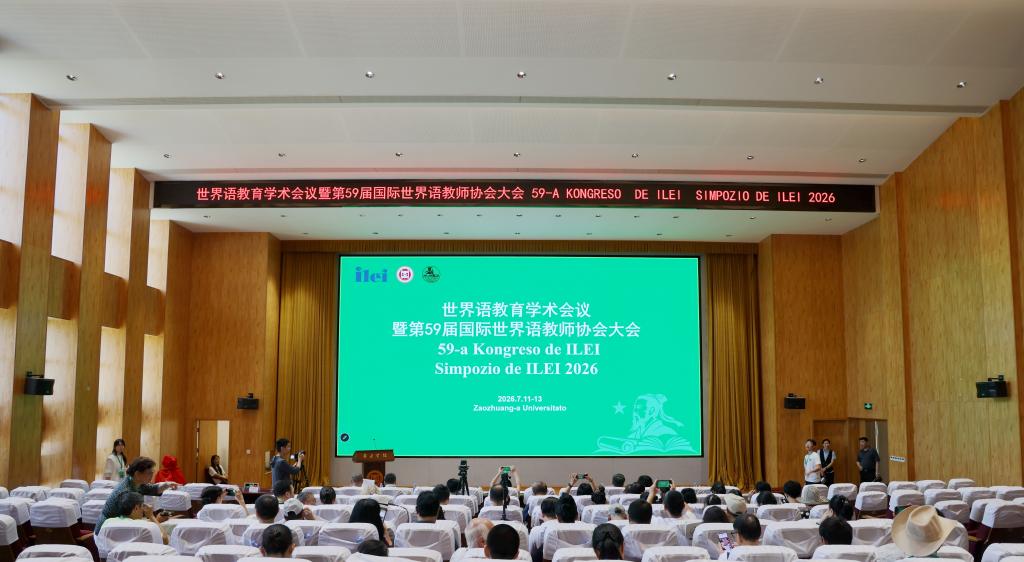
More than 30 international guests attended the conference, including Alessandra Madella, vice president of ILEI and professor of Esperanto at Zaozhuang University; Laura Brazzabeni, president of the Italian Esperanto Federation; Bengt-Arne Wickström, an academician of the International Academy of Sciences San Marino and former deputy director of the German Institute for Economic Research; Dmitrij Sevcenko, editor-in-chief ofEsperanto, the official journal of the Universal Esperanto Association (UEA); and heads of Esperanto associations from Belgium, Romania, the Republic of Korea, Japan, Mongolia, and Burundi. Ahmad Reza Mamduhi, president of ILEI, and more than 20 other scholars from Poland, Austria, India, and other countries participated in the opening ceremony online.
The opening ceremony was attended by Liu Dawei, president of the China Esperanto League (CEL) and former deputy director of China International Communications Group (CICG); Yang Huaiguang, deputy director of the Foreign Affairs Office of the People’s Government of Shandong Province; Sun Bo, member of the Party Leadership Group and deputy director of the Shandong Provincial Department of Culture and Tourism, and deputy director of the Shandong Provincial Bureau of Cultural Relics; Yan Ming, president of the China Branch of ILEI and former vice president of Heilongjiang University; Chen Ji, director of the Esperanto Division of the Asia-Pacific Center of CICG and secretary-general of CEL; Yu Jian, a second-level investigator in the Division of International Communication of the Publicity Department of the CPC Shandong Provincial Committee; Rong Ruifeng, director of the Museum and Social Cultural Relics Division of the Shandong Provincial Department of Culture and Tourism; Gong Xiaofeng, standing committee member of UEA and professor at Nanchang University; Song Lei, member of the Party Leadership Group and vice mayor of Zaozhuang Municipal People’s Government; Gao Feng, secretary of the CPC Zaozhuang University Committee; Cong Hailin, deputy secretary of the CPC Zaozhuang University Committee and president of Zaozhuang University; Hu Xiaolin, former secretary of the CPC Zaozhuang University Committee; Chu Fumin, member of the CPC Zaozhuang University Committee and vice president of Zaozhuang University; and Yan Xin, member of the CPC Zaozhuang University Committee and director of the Publicity Department. The conference was chaired by Cong Hailin, deputy secretary of the CPC Zaozhuang University Committee and president of Zaozhuang University.
The ceremony opened with a performance ofLa Espero(“The Song of Hope”). Gao Feng extended a warm welcome and expressed his sincere gratitude to the international guests andalldelegates on behalf of the university’s faculty and students. He noted that Zaozhuang University is one of the earliest institutions in China to engage in Esperanto education, research, and cultural preservation and dissemination. Together with CEL, the university has established the world’s largest Esperanto museum in terms of exhibition space, launched the world’s only Esperanto undergraduate program, and translated, compiled, and published a series of books on the study and dissemination of Chinese culture in Esperanto. Gao emphasized that this conference brought together Esperanto scholars from around the world, making it a high-level international academic event, and expressed his hope that participants would deepen exchanges and jointly advance the development of Esperanto.
Song Lei, on behalf of the Zaozhuang Municipal People’s Government, extended warm congratulations on the opening of the conference and a sincere welcome to Esperanto educators, scholars, and friends from both China and abroad. He noted that Zaozhuang, located in southern Shandong, is renowned as the “Pearl of the Grand Canal” and “The City of Pomegranates and Craftsmanship.” He said that Zaozhuang’s culture of openness, inclusiveness, and mutual respect aligns closely with Esperanto’s ideals of equality, inclusiveness, and peace. Song pointed out that Zaozhuang University has developed a distinctive Esperanto education system in China, making it a global benchmark for Esperanto education. He cordially invited all participants to visit Zaozhuang and work together to foster a new model of people-to-people and cultural exchanges between China and other countries.
Alessandra Madella noted in her address this was the second time the congress had been held in China, following its 2012 session in Kunming. She commended Zaozhuang University for being home to the world’s largest Esperanto museum in terms of exhibition space, saying that it provided the university with a unique advantage in hosting the event. She called on participants to explore together the history, practice, and future of Esperanto education. She firmly believes that Esperanto is an important bridge for disseminating Chinese civilization and promoting mutual learning among Chinese and foreign civilizations.
Yan Ming noted in his address that ILEI, as a specialized organization of UEA and a UNESCO consultative organization, is dedicated to the global promotion of Esperanto education, cross-cultural communication, and academic research. The congress focused on cutting-edge topics such as Esperanto education, talent development, professional applications, and linguistic cognition, which are closely aligned with current trends in language education. He added that this conferencewas of great significance to advancing teaching reform and deepening international cultural exchanges.
Also speaking were Ikuko Kitagawa, president of the Japanese Esperanto Institute; Lee Jungkee, director of the Seoul Esperanto Cultural Institute; Bengt-Arne Wickström, professor at Humboldt University Berlin; Francois Le Jacomo, secretary-general of the International Esperanto Academy; Aime Patrick Manirakiza, president of the Burundi National Esperanto Association; and Dmitrij Sevcenko, editor-in-chief of Esperanto. They said that Zaozhuang University’s achievements in developing Esperanto-related academic programs, preserving Esperanto culture through the museum, and promoting international academic exchanges were impressive, and they looked forward to deepening cooperation with China’s Esperanto education community through the conference.
In his speech, Yang Huaiguang noted that Esperanto, with its original mission of eliminating language barriers and promoting equal communication, is highly compatible with China’s vision of promoting exchanges and mutual learning among civilizations and building a community with a shared future for mankind. He commended Zaozhuang University for its practical achievements in using Esperanto as a bridge to connect the global academic community and disseminate Qilu culture (the local culture of Shandong Province). He added that the Foreign Affairs Office of the People’s Government of Shandong Province would fully leverage the intellectual resources and research findings of the provincial foreign affairs think tank system to support the university’s Esperanto discipline development and academic activities. He also stated that the Office would actively engage with Esperanto organizations at home and abroad to better serve China’s overall diplomacy and Shandong’s high-standard opening-up and international engagement.
Liu Dawei said in his speech that since its founding more than seventy years ago, ILEI has been dedicated to research on Esperanto education, teacher training, textbook compilation, and international educational exchange, playing a significant role in promoting the standardization, professionalization, and internationalization of Esperanto education. The congress’s return to China, and its being held in Zaozhuang, Shandong, are of profound significance — Zaozhuang, the venue, is the hometown of Mozi, and Mozi’s philosophy of “universal love, opposition to aggression, and respect for the worthy and inclusiveness” closely accords with Esperanto’s founding ideals of equal dialogue among people, mutual learning among civilizations, and peaceful coexistence. He hopedthat all participants would make the most of this opportunity for exchange and engage in in-depth discussions on innovative approaches and development opportunities for Esperanto education in the new era.
At the opening ceremony, a congratulatory video from Ahmad Reza Mamduhi,president of ILEI, was played. Faculty members of Zaozhuang University then read out congratulatory letters from UEA, ILEI, and Esperanto organizations in Brazil, Iran, Japan, Poland, India, the Republic of Korea, and other countries. This was followed by the unveiling ceremony for the Esperanto Teaching, Research, and Cultural Preservation Base. Gao Feng and Alessandra Madella jointly unveiled the plaque for the base in recognition of the university’s outstanding contributions to the development of its undergraduate Esperanto program, cultural preservation at the Esperanto Museum, and the translation and international dissemination of Chinese classics in Esperanto.
This conference was jointly organized by ILEI and Zaozhuang University with the theme of “Professional Talent Development in Esperanto and the Preservation of Esperanto Culture.” It not only provided a high-level platform for academic exchange among Esperanto educators and researchers from around the world, but also promoted the development of Esperanto education and intercultural exchange, thereby harnessing the power of language to foster a global community with a shared future.
Also attending the opening ceremony were representatives from universities across China; heads of Esperanto organizations from various provinces and cities; Esperanto enthusiasts; Ma Qian, director of the Foreign Affairs Office of Zaozhuang Municipal People’s Government; Huang Yingying, member of the Party Leadership Group of the Zaozhuang Municipal Bureau of Culture and Tourism, secretary of the Party Committee and director of the Zaozhuang Municipal Cultural Tourism Development Center; heads of Zaozhuang’s cultural and museum institutions and education authorities; and representatives from the University Office, the Office of Social Sciences, the International Exchange Office (School of International Education), and the School of Foreign Languages (Department of College English) of Zaozhuang University.
Text and photos: International Exchange Office (School of International Education)
Editor: Ge Xiaoxia
Reviewer: Yan Xin


 鲁公安网备37040002002001号