From October 17 to 18, the 2026 Annual Conference of the Shandong Association of Linguistics Abroad (SALA) was held on the Xuecheng Campus of Zaozhuang University. The conference was hosted by the SALA and organized by the School of Foreign Languages (Department of College English) of Zaozhuang University. More than 120 experts and scholars from across the province and beyond gathered to discuss the theme: “The Construction and Innovative Development of an Independent Knowledge System for Foreign Linguistics in the Age of Artificial Intelligence.” Cong Hailin, Deputy Secretary of the CPC Zaozhuang University Committee and President of Zaozhuang University, and Ma Wen, President of the SALA and Dean of both the School of Foreign Languages and Literature and the School of Translation Studies at Shandong University, attended the opening ceremony and delivered opening speeches. Chu Fumin, Member of the CPC Zaozhuang University Committee and Vice President of Zaozhuang University, presided over the opening session.
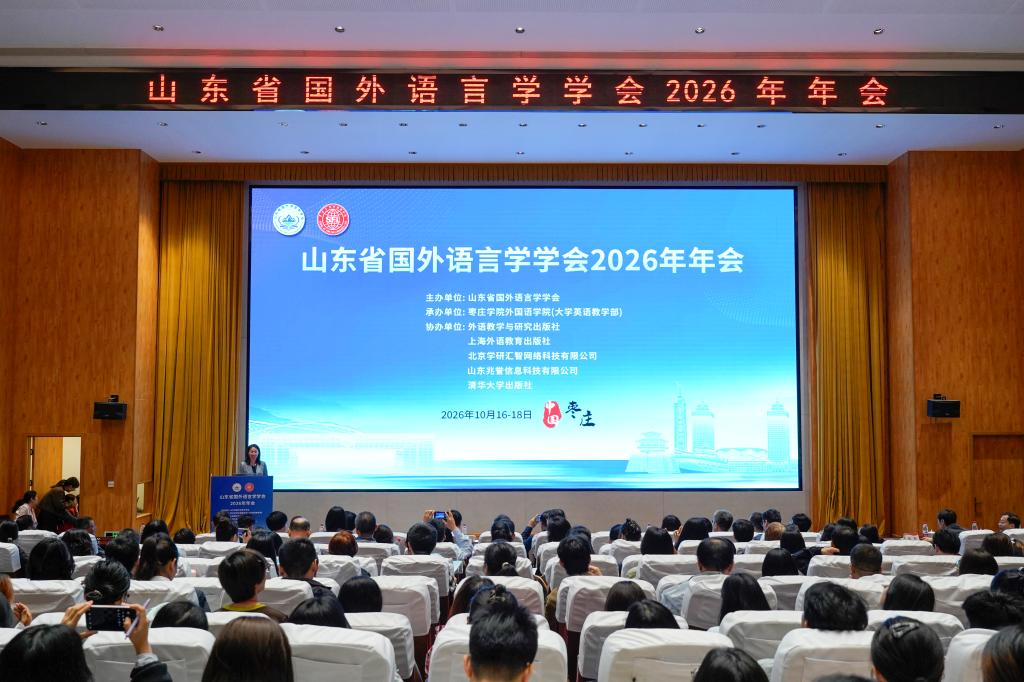
Cong Hailin extended a warm welcome to the attending experts and scholars on behalf of the university, and expressed sincere thanks to the association and fellow specialists for their enduring support. He introduced Zaozhuang University’s institutional positioning, recent progress, and distinctive academic resources, including its undergraduate program in Esperanto and the Esperanto Museum. Cong pointed out that foreign language education plays an essential role in fostering students’ humanistic literacy, enhancing intercultural communication competence, and advancing the university’s international engagement. He affirmed that the university will continue to support the development of foreign language disciplines, foster an enabling environment for faculty scholarship and academic exchanges, and deepen the integration of language training with professional skills and practical applications, so as to better serve talent cultivation and regional development. He expressed confidence that the conference would foster deeper inter-institutional partnerships and translate scholarly insights into tangible achievements in teaching and discipline building.
In his address, Ma Wen reviewed the association’s 31-year academic legacy and commended Zaozhuang University for its strong backing of foreign language disciplines and its meticulous conference organization. He observed that, in response to AI advancements and discipline transformation, the academic community should maintain fundamental linguistic principles while embracing innovation. Scholars should leverage the humanistic foundation of language studies and actively explore human–AI interaction, AI-assisted linguistic analysis, and modern teaching paradigms. Ma stressed that building an independent Chinese knowledge system demands grounding in domestic practice, identifying valuable academic questions, and advancing theoretical understanding through rigorous evidence and argumentation. He affirmed that the SALA will continue to promote university collaborations, support emerging young researchers, and bridge the gap between academic research, educational practice, and public communication.
Chu Fumin noted in her remarks as session chair that the annual conference offered a valuable platform for the academic community to reflect collaboratively on discipline development in the AI era and share innovative pedagogical and research practices.
During the keynote session, eight prominent scholars delivered presentations: He Wei (Beijing Foreign Studies University), Jiang Feng (Beihang University), Zhang Yi (Nanjing University), Lei Lei (Shanghai International Studies University), Zhang Yanfei (Shandong University), Yang Yanning (East China Normal University), He Wenzhong (Zhejiang University), and Qin Hongwu (Qufu Normal University). Their reports addressed frontline topics including core linguistic issues in the AI era, AI-assisted language research, academic English instruction and literacy development, digital-intelligent international communication and translation, and the relationship between pragmatics and semantics.
The conference featured four thematic forums focusing on translation innovation, international dissemination of Chinese culture, foreign language teaching and faculty development, and linguistic theory, exploring new pathways for research in foreign linguistics and educational practice in the age of artificial intelligence. In addition, attending experts visited the School of Foreign Languages (Department of College English) to provide on-site guidance on curriculum design, talent cultivation, disciplinary development, and the drafting of the university’s 15th Five-Year Plan (2026–2030).
At the closing ceremony, Ma Wen summarized the conference achievements around three key themes: “Questioning, Verification, and Connection,” emphasizing theoretical depth, empirical evidence, and the vital link between research and social practice, so as to jointly advance the construction of an independent knowledge system for foreign linguistics.
Party and administrative leaders, faculty members, and student representatives from Zaozhuang University’s School of Foreign Languages (Department of College English)) attended the conference.
Text: School of Foreign Languages (Department of College English);
Photos: School of Foreign Languages (Department of College English) and Li Shenlei;
Editor: Ge Xiaoxia;
Reviewer: Yan Xin



 鲁公安网备37040002002001号
